Cuba is perhaps best known for its socialism, salsa, rum, vintage cars and cigars rather than its gastronomy but amid the decaying colonial buildings and pot-holed streets of a city which until recently appears to have been stuck in a 1950s timewarp, there can now be found a few hidden gems.
In the 1950s, American movie stars and gangsters ruled the roost in this vibrant Caribbean city by gambling and partying until the place rocked. And rocked it was when Castro and his revolutionaries swept to power. A population exodus, the US blockade and an era of isolation followed in which socialist friends supported the remaining population of this small island state and its charismatic leader in their stance against the might of Uncle Sam and his cronies.
Times change and the latter half of the 1990s saw Cuba follow its socialist pals by somewhat reluctantly embracing a more 'commercial' form of socialism. Tourism. Poor infrastructure, tight government control and restricted imports, however, mean that the industry has not been able to flourish in quite the same way as its Caribbean neighbours. In terms of servicing the tourists most hotels and restaurants are state controlled. Restaurants often have limited menus due to food rationing and although cheap are not usually able to stretch much beyond providing the average customer with something to line their stomach. Indeed, there is a Cuban joke about the standard of the cuisine, "The three great gains of the revolution - health, education and culture - have been at the expense of breakfast, lunch and dinner."
The government eventually decided that private individuals should be given the chance to profit from the growing tourist market and so introduced 'paladares'. Apparently named after a restaurant in Brazilian soap opera these small restaurants are able to offer home-cooked food despite being evermore tightly controlled and subject to a wealth of regulations. These regulations include a limit of the number of diners, theoretically a maximum of twelve, and rules that employees must be family members and that seafood or beef cannot be served. Free enterprise has not completely arrived. However, the paladares existence means that tourists can sample something other than the staple tourist fare of comida criolla (chicken, pork rice and beans), moros y cristianos (beans and rice) or peso pizza. Paladar prices are still out of reach for most Cubans so don't expect to be dining with the locals.
Paladares vary in standards but one that has attracted some notoriety both for its clientele and cuisine is La Guarida ('the hideaway or den'). Hard to find in a residential area of Vedado, only the bouncers on the door would suggest anything special lies behind the crumbling walls of this former palace, now an apartment building.
Washing hangs from clotheslines, a dusty old car is parked in the former entrance hall and as you climb the winding marble staircase that once exhibited more grandeur than it does today you might even see a gaggle of children playing baseball in the former ballroom, at one time more used to dancing than batting. Eventually you reach the third floor and through a wooden door you feel as if you have entered a brave new world. La Guarida is in reality an apartment like many of the others on the corridor but its mustard yellow walls, cluttered Cuban kitsch decoration and photographs of famous American visitors coupled with the flavoursome aromas emanating from the tiny kitchen sandwiched between the dining rooms make it feel atmospheric and as if you are somehow subverting the Cuban socialist ideal.
Indeed, La Guarida does have what some may consider to be a 'subversive' past. Tomás Gutiérrez Alea's controversial and Oscar-nominated Cuban film 'Fresa y Chocolate' (Strawberries and Chocolate) was shot here during the early 1990s, considered to be a black period for Cuba when the fall of the Soviet Union lead to an economic crisis as Cuba lost a key financial backer. The title of the film refers to ice cream flavours - the colour of strawbery ice cream, pink, is a metaphor for homosexuality and creativity, the brown of the chocolate symbolises the daily slog of state-controlled life. Tasting his ice cream, one of the film's main protagonists remarks that it, "is the only good thing left in this country. Soon they'll export it, and for us ... water and sugar." Today, film-makers and film stars visit the former film set. Uma Thurman, Benicio del Toro, Jack Nicholson, Pedro Almodovar and Steven Spielberg have all eaten here.
The food is considered to be nuevo Latin cuisine combining local ingredients in a fusion of Cuban and European styles. Whilst it may not rival that served in restaurants across the water it does attempt to move away from the more staple Cuban dishes and add a creative twist in terms of combining meat and fish dishes with more exotic flavours, for example, tuna in a coconut sauce. The bar is fully stocked but, be warned, don't ask for a Bacardi rum, the Bacardi family are not flavour of the month in Cuba. Havana Club is a better option. Things have moved on from Cuba's dark days when the Soviet Union collapsed, the Russians left and the period when 'Fresa y Chocolate' was set. Now there is a lot more than ice cream on the menu, although you can have your own taste of strawberry and chocolate ice cream, and Cuba can begin to think about exporting its positive gastronomic reputation rather than simply water and sugar.
Meal for 2 including drinks: approx $40
Reservations recommended.
La Guarida
Concordia No.418 /Gervasio y Escobar.
Centro Habana.
Havana
Tel: (537) 863-7351, 866-9047
Spanish website:
http://www.laguarida.com/index.php
Showing posts with label Cuba. Show all posts
Showing posts with label Cuba. Show all posts
Tuesday, February 06, 2007

Tuesday, April 18, 2006
Hemingway's Havana Haunts, Havana, Cuba
Ernest Hemingway...American novelist, short-story writer, journalist, Nobel prize winner, ambulance driver, fisherman, secret agent, playboy, animal-lover, madman, alcoholic? Whichever title you choose, 'Papa' was his own preferred nomenclature, certainly during his time in residence on the Caribbean island of Cuba, his adopted home for two decades.
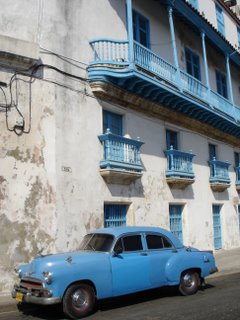 Today, Cuba's architectural glory is literally crumbling and you could be forgiven for feeling you have stepped into a time-machine and been transported to a former age as 1950s Chevrolet after 1950s Chevrolet passes you by in varying shades of pastel-ness. Despite initial appearances and if you look beyond the flaking paint and the cracking walls there lie hidden gems waiting to be discovered. One of these, the city of Havana, which in part is now a UNESCO world heritage site and gradually being restored, played host to 'Papa' Hemingway and provided inspiration for some of his most famous works. As you tour Havana's intoxicating old town, it is quite easy to punctuate your efforts with stops at the former drinking dens of the renowned drinker.
Within staggering distance of Edificio Bacardi, the former headquarters of the Bacardi rum clan, now famously at loggerheads with the Cuban government and no longer producing rum in Cuba, there's the Floridita. This bar is where Hemingway would come to drink daiquiris on his way home to his four dogs and 57 cats at Finca Vigia, his farm on the outskirts of the city. Hemingway once said that alcohol was his “best friend and severest critic”. After twelve daiquiris, reputedly Hemingway's normal intake in one session, it is perhaps easy to see why he considered the relationship a close one. Although partial to daiquiris as he was, Hemingway created his own version of the cocktail, now immortalised as the ‘Papa Doble’. The traditional Floridita daiquiri contains lime juice, a dash of maraschino, a shot of rum and half a teaspoon of sugar over crushed ice. Hemingway's variation cut out the sugar and doubled the rum!
 La Bodeguita del Medio, located close to Plaza de la Cathedral was another regular hangout of Hemingway's being where he would come when he fancied an alternative to the daiquiris. This bar and
 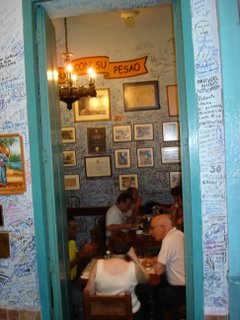 restaurant, was where Papa would indulge in a mojito or two and, supposedly, endorsed his penchant for this establishment's particular concoction of rum, sugar, mint, water and ice by adding his name to the graffiti on the walls. Nowadays, the place is overrun with tourists and sadly, can no longer be said to serve the best mojitos in town. One suspects the management believe poor service, over-salted food and weak drinks can be compensated for by the curiosity value of the scribbled-on walls and celebrity photographs adorning them. Hemingway is no doubt turning in his grave at the state of the watering hole he once loved.
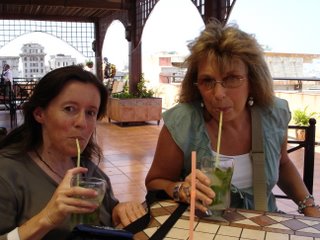 For many years, Papa Hemingway stayed at the Hotel Ambos Mundos, close to the Plaza des Armes. The hotel has recently been renovated and now looks stylishly modern yet retains much of its traditional character. Hemingway stayed in Room 511, which can be viewed, at a fee for non-hotel guests, for seven years and is known to have worked on "For Whom the Bell Tolls" during this time. Today, the rooftop restaurant, reached by the birdcage lift, serves great mojitos and would perhaps be a more worthy recipient than La Bodeguita for 'the best mojito in town' award, although it should be said they are by no means the cheapest.
As you tour Cuba Hemingway's literary legacy lingers on but it has to be said that he has also left another legacy, of a more liquid kind, in Havana. Perhaps a more appropriate title for Papa Hemingway might be 'Old Man of the C'...the C standing for cocktail?
La Floridita
Obispo No.557 esq. a Monserrate
Tel:(53-7) 867 1299 or 867 1300 or 867 1301 Ext. 128
Fax:(53-7) 33 8856 or 86 68856
Weblink: http://www.floridita-cuba.com
La Bodeguita del Medio
Empedrado entre Cuba y San Ignacio
(Near Plaza de la Cathedral)
Tel: 62-4498
Hotel Ambos Mundos
Calle Obispo 153
(Near Plaza des Armes)
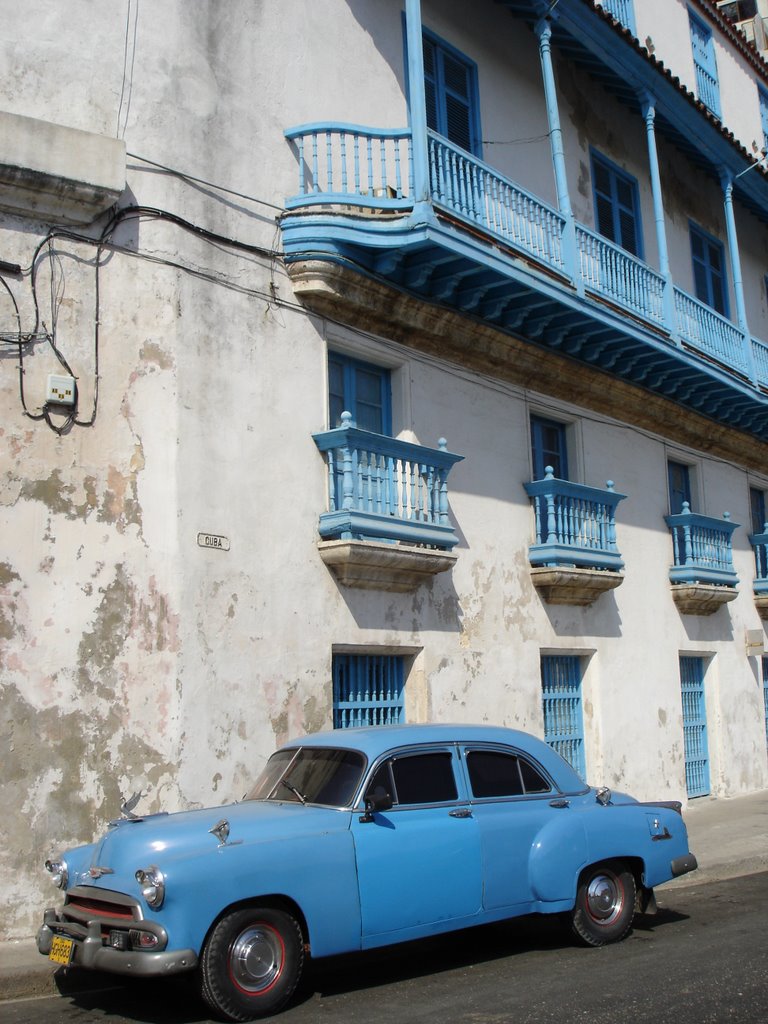 Today, Cuba's architectural glory is literally crumbling and you could be forgiven for feeling you have stepped into a time-machine and been transported to a former age as 1950s Chevrolet after 1950s Chevrolet passes you by in varying shades of pastel-ness. Despite initial appearances and if you look beyond the flaking paint and the cracking walls there lie hidden gems waiting to be discovered. One of these, the city of Havana, which in part is now a UNESCO world heritage site and gradually being restored, played host to 'Papa' Hemingway and provided inspiration for some of his most famous works. As you tour Havana's intoxicating old town, it is quite easy to punctuate your efforts with stops at the former drinking dens of the renowned drinker.
Within staggering distance of Edificio Bacardi, the former headquarters of the Bacardi rum clan, now famously at loggerheads with the Cuban government and no longer producing rum in Cuba, there's the Floridita. This bar is where Hemingway would come to drink daiquiris on his way home to his four dogs and 57 cats at Finca Vigia, his farm on the outskirts of the city. Hemingway once said that alcohol was his “best friend and severest critic”. After twelve daiquiris, reputedly Hemingway's normal intake in one session, it is perhaps easy to see why he considered the relationship a close one. Although partial to daiquiris as he was, Hemingway created his own version of the cocktail, now immortalised as the ‘Papa Doble’. The traditional Floridita daiquiri contains lime juice, a dash of maraschino, a shot of rum and half a teaspoon of sugar over crushed ice. Hemingway's variation cut out the sugar and doubled the rum!
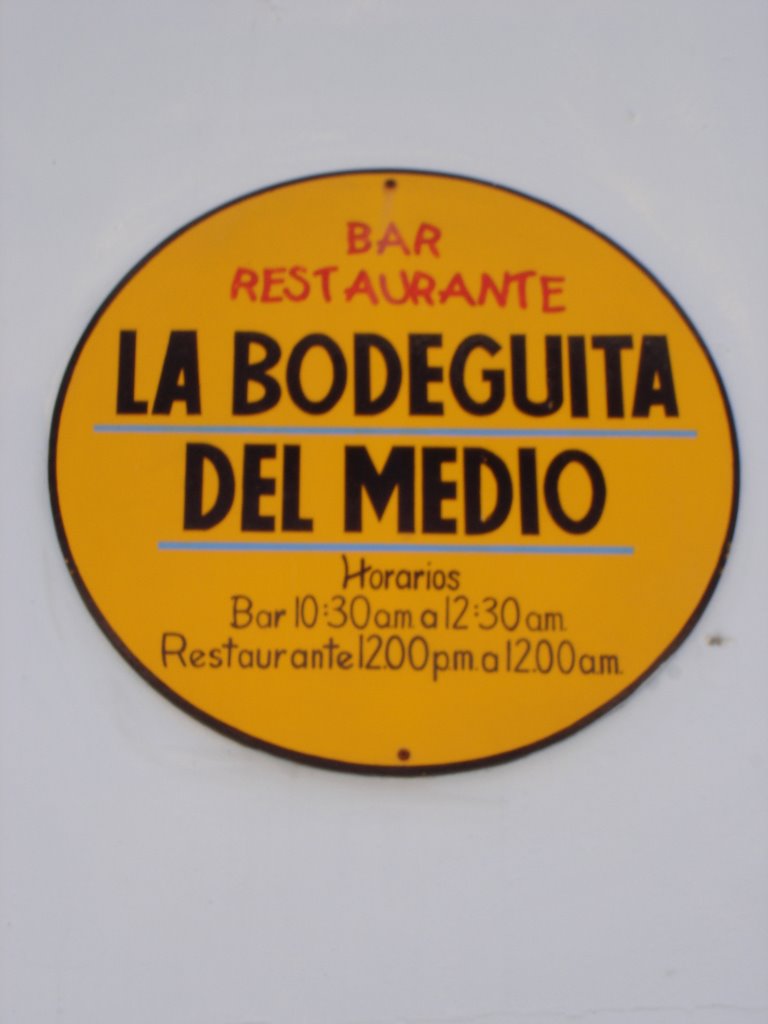 La Bodeguita del Medio, located close to Plaza de la Cathedral was another regular hangout of Hemingway's being where he would come when he fancied an alternative to the daiquiris. This bar and
 restaurant, was where Papa would indulge in a mojito or two and, supposedly, endorsed his penchant for this establishment's particular concoction of rum, sugar, mint, water and ice by adding his name to the graffiti on the walls. Nowadays, the place is overrun with tourists and sadly, can no longer be said to serve the best mojitos in town. One suspects the management believe poor service, over-salted food and weak drinks can be compensated for by the curiosity value of the scribbled-on walls and celebrity photographs adorning them. Hemingway is no doubt turning in his grave at the state of the watering hole he once loved.
 For many years, Papa Hemingway stayed at the Hotel Ambos Mundos, close to the Plaza des Armes. The hotel has recently been renovated and now looks stylishly modern yet retains much of its traditional character. Hemingway stayed in Room 511, which can be viewed, at a fee for non-hotel guests, for seven years and is known to have worked on "For Whom the Bell Tolls" during this time. Today, the rooftop restaurant, reached by the birdcage lift, serves great mojitos and would perhaps be a more worthy recipient than La Bodeguita for 'the best mojito in town' award, although it should be said they are by no means the cheapest.
As you tour Cuba Hemingway's literary legacy lingers on but it has to be said that he has also left another legacy, of a more liquid kind, in Havana. Perhaps a more appropriate title for Papa Hemingway might be 'Old Man of the C'...the C standing for cocktail?
La Floridita
Obispo No.557 esq. a Monserrate
Tel:(53-7) 867 1299 or 867 1300 or 867 1301 Ext. 128
Fax:(53-7) 33 8856 or 86 68856
Weblink: http://www.floridita-cuba.com
La Bodeguita del Medio
Empedrado entre Cuba y San Ignacio
(Near Plaza de la Cathedral)
Tel: 62-4498
Hotel Ambos Mundos
Calle Obispo 153
(Near Plaza des Armes)
Subscribe to:
Posts (Atom)